25 April 2026
Kota Baca 2026 was a free three-day book fair held at Dataran Merdeka, Kuala Lumpur from 24 to 26 April 2026, organised by Perbadanan Kota Buku in conjunction with World Book Day. The event featured over 80 publisher and bookseller booths, a main stage with talks and performances, an AI learning zone, a book donation station, and themed activities across the historic square and surrounding grounds.
The first thing I noticed wasn't the books.
It was the quotes.
Tall red pillars stood at intervals across Dataran Merdeka — each one carrying a line from a Malaysian author, printed large enough to read from a distance. One stopped me mid-step. Nisah Haron, from Lentera Nilam: "Buku adalah pasport paling murah untuk kita mengelilingi dunia ilmu." A book is the cheapest passport to journey through the world of knowledge.
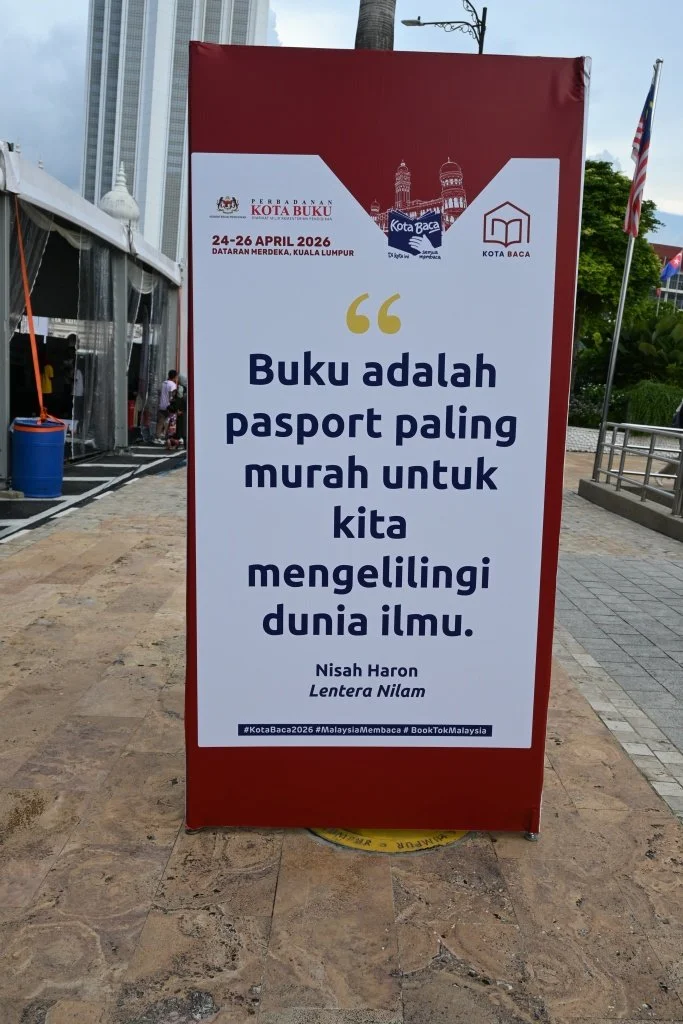
Buku adalah pasport paling murah untuk kita mengelilingi dunia ilmu board
I stood there a moment longer than I needed to.
It's a good line. And standing in the midday heat outside one of the most photographed buildings in Malaysia, with a book fair spreading out across the square in front of me, it landed differently than it would have on a page.
What Does Kota Baca Actually Look Like From the Inside?
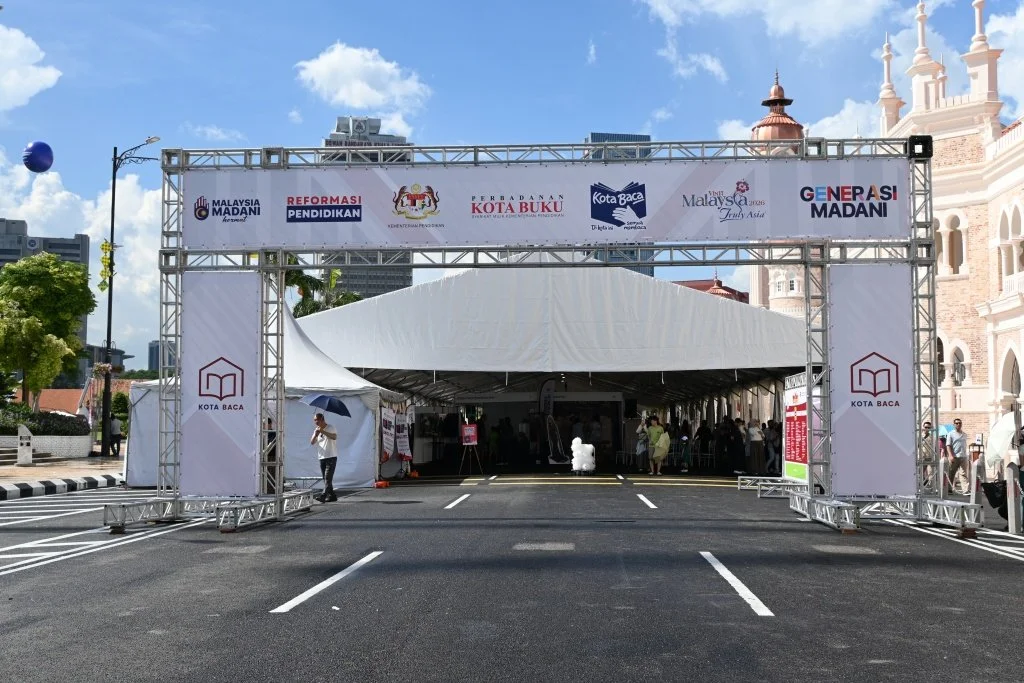
Entrance
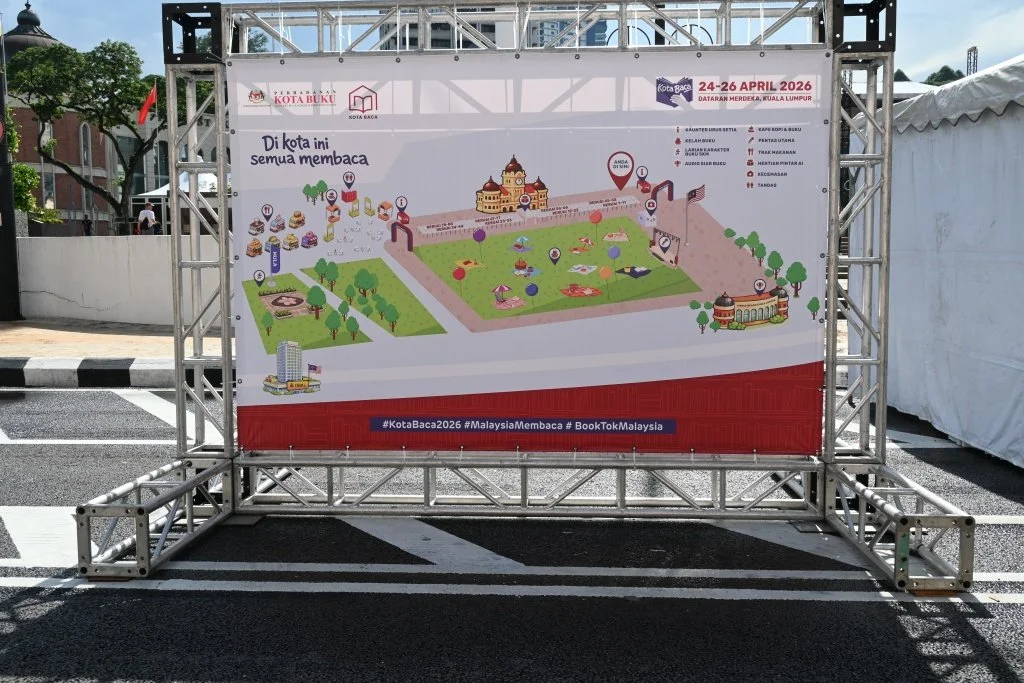
Overview of Kota Baca
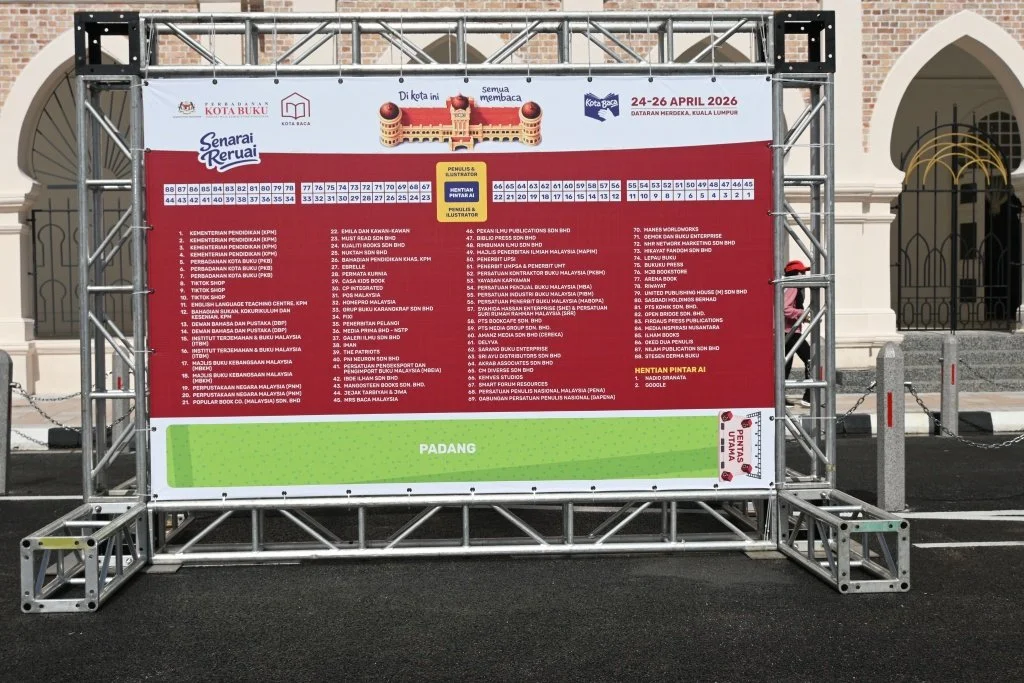
List of exhibitor
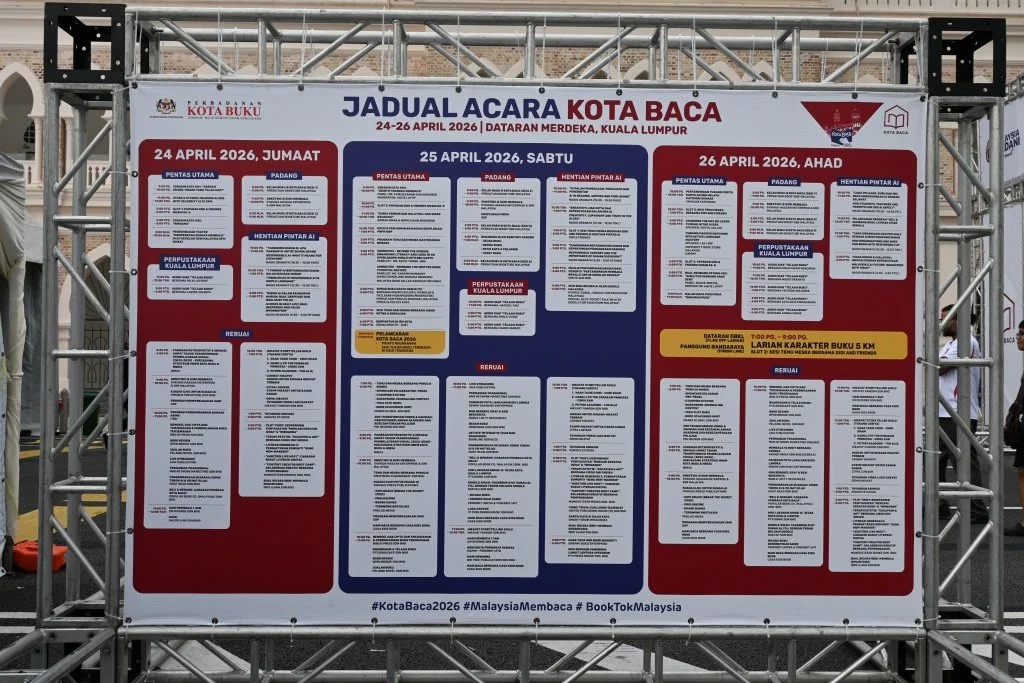
List of 3-day (24-26 April 2026) program
The event is bigger than it appears from the entrance arch. Once you walk through, the layout splits across several zones: a covered exhibition tent housing 80-plus booths, an open padang with reading spots and large balloons anchored to the grass, a main stage for talks and performances, and a few standalone stations including the one labelled Hentian Pintar AI — the AI Learning Stop.
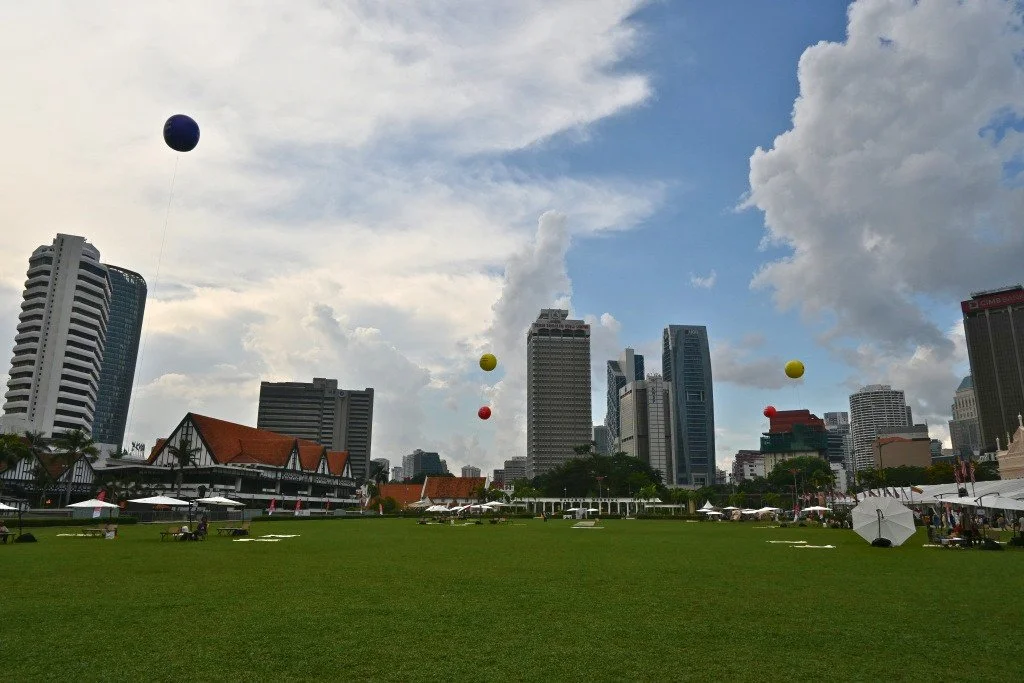
Overview from Dataran Merdeka
The booth list alone reads like a cross-section of Malaysia's publishing industry. Dewan Bahasa dan Pustaka. Institut Terjemahan & Buku Malaysia. The National Library of Malaysia, promoting their u-Pustaka platform — free digital reading, which I thought was one of the more useful things on show. A book donation station (Stesen Derma Buku) where visitors could drop off pre-loved books. An entire corner dedicated to Kota Baca merchandise — red bucket hats, mugs, illustrated t-shirts, hand fans bearing the event's tagline: di kota ini, semua membaca. In this city, everyone reads.
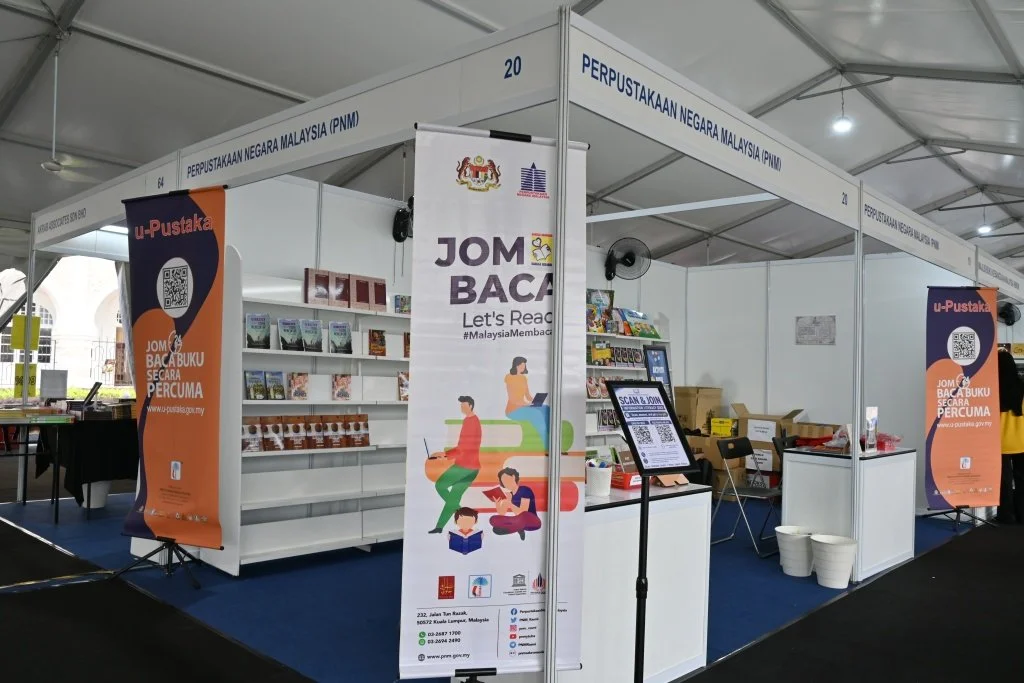
Perpustakaan Negara Malaysia booth
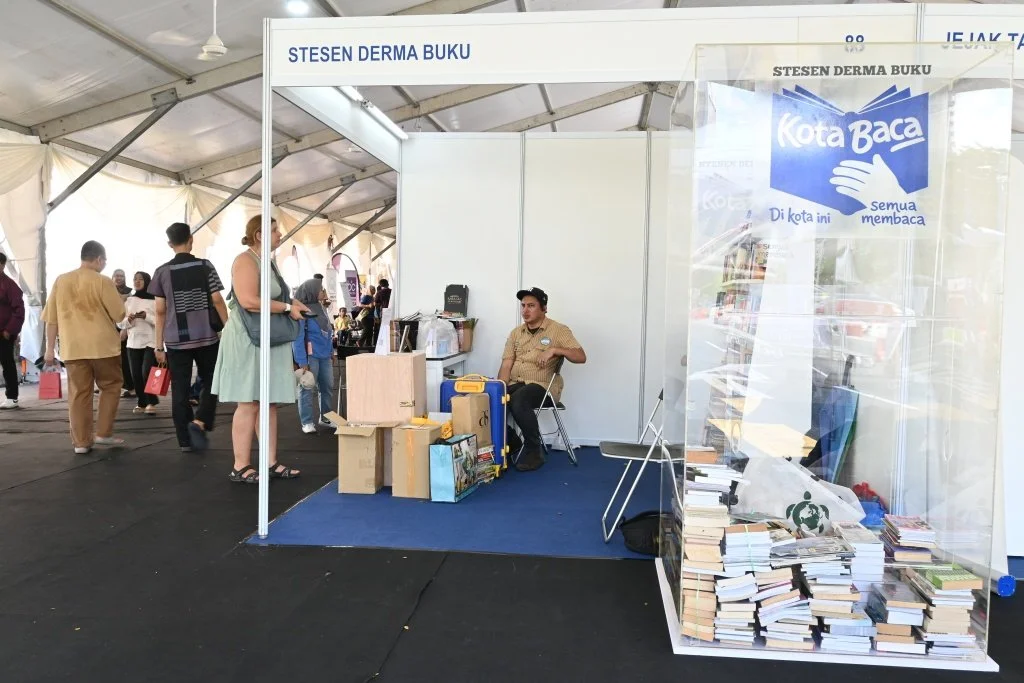
Stesen Derma Buku for books donation
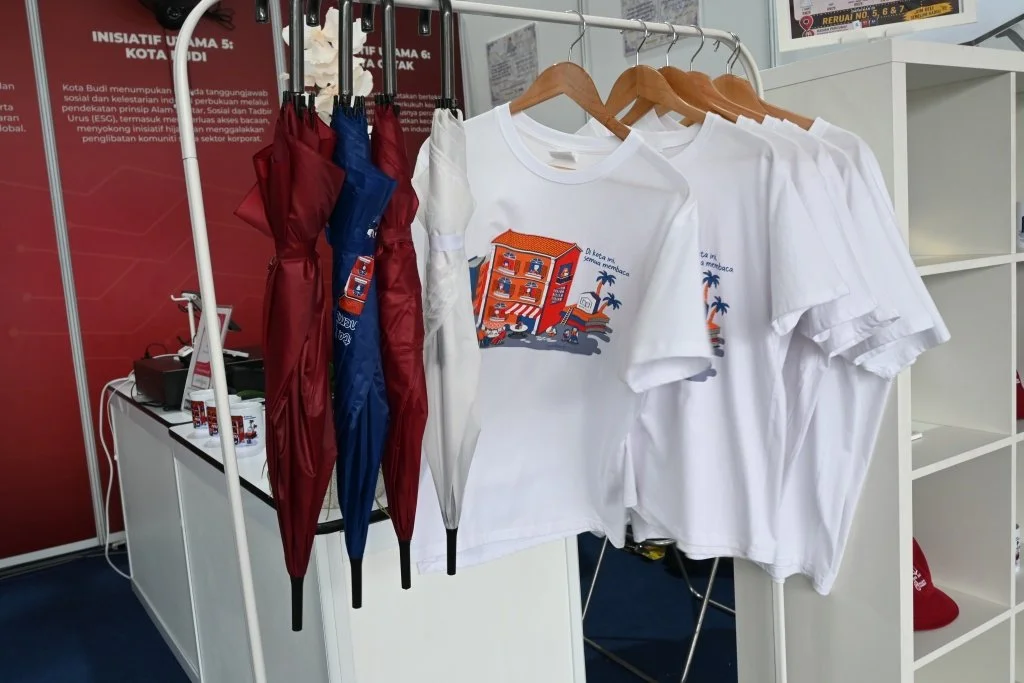
Kota Baca merchandise
I caught part of a session at the Hentian Pintar AI — a Google talk projected onto a large screen, walking through how AI tools are reshaping the way we learn. It felt both timely and slightly surreal: a technology designed to compress information, demonstrated at an event built around the very act of reading slowly.
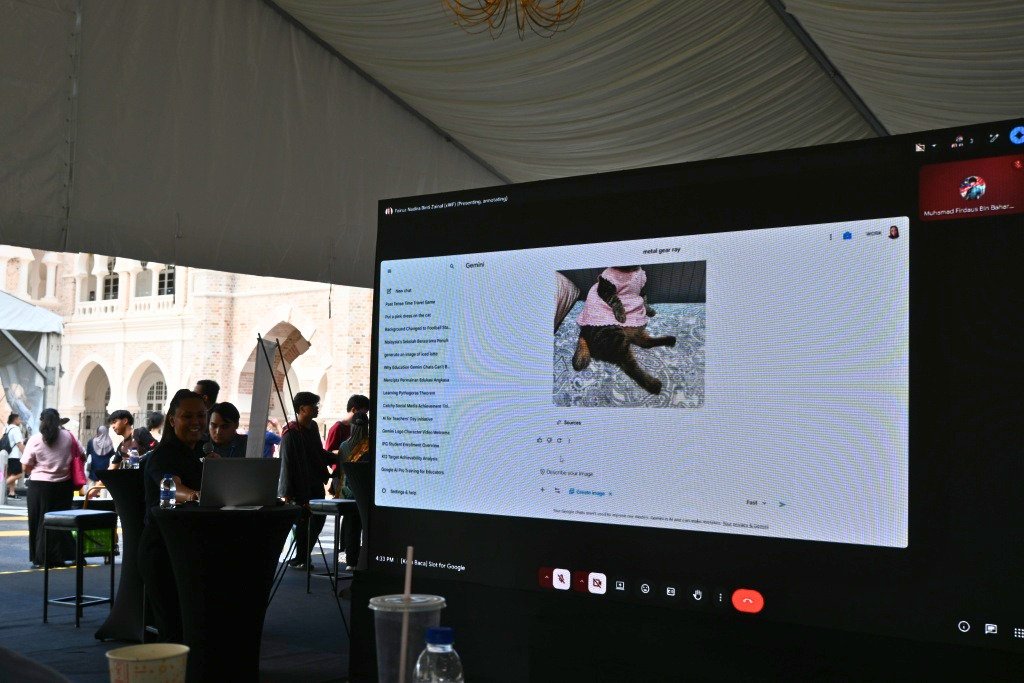
Google rep give talk about AI for education at Hentian Pintar AI
The Bingkai Harapan Dunia — Frame of the World's Hope — was one of the more quietly affecting installations. Visitors could take a polaroid photo, write their wish or hope onto it, and pin it onto a large red wall that was slowly filling up with faces and handwritten words. By the time I got there, the board was already covered. There's something about a wall of strangers' handwriting that makes a space feel less like an event and more like a conversation.
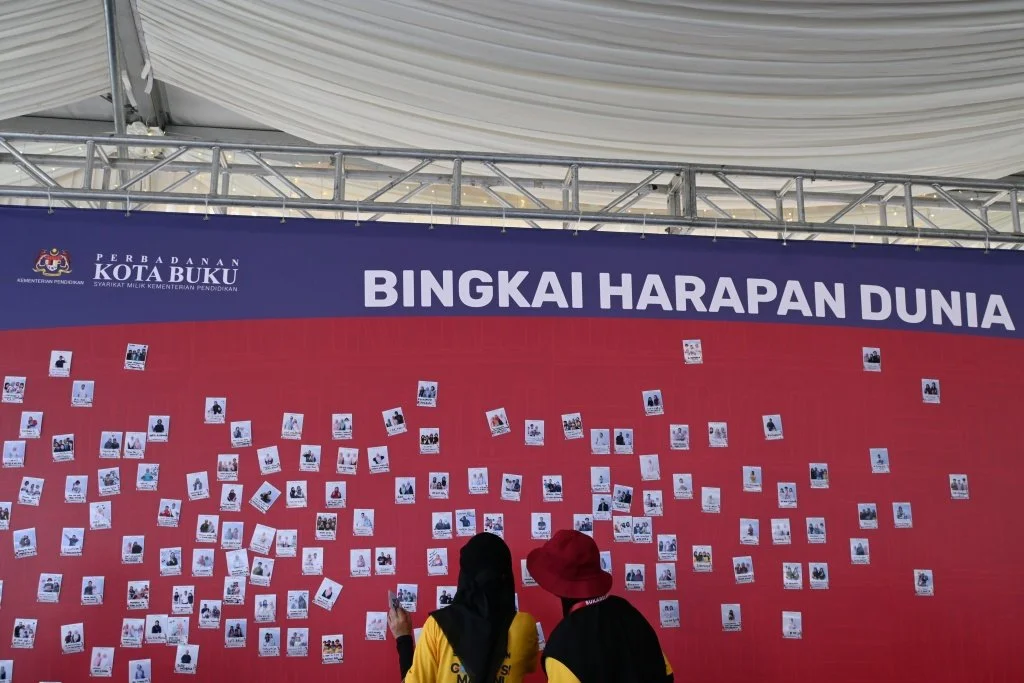
Bingkai Harapan Dunia
The Kota Baca Passport was a nice touch — a physical stamp book you could collect from the Perbadanan Kota Buku booth and get stamped at participating booths. It gave you a reason to move through the space intentionally rather than drifting from booth to booth without direction. I appreciated the idea.
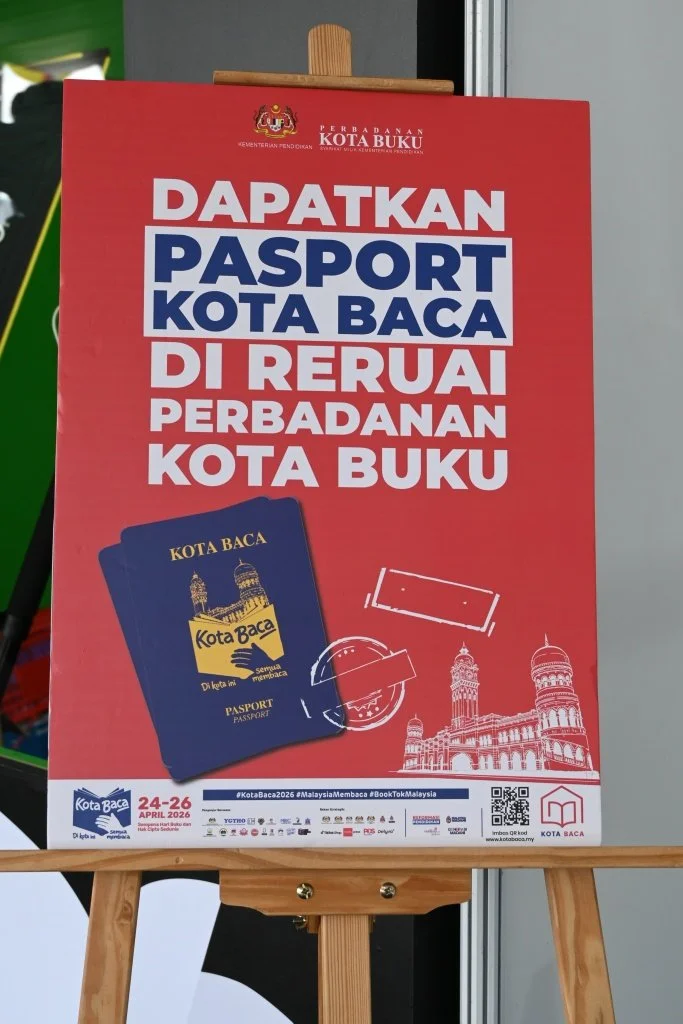
Pasport Kota Baca for stamp collection
Kota Baca 2026 is free to enter, spans multiple zones across Dataran Merdeka, and includes activities beyond book shopping.
Reading Should Not Be a Luxury
The quote pillars scattered around the event kept returning me to the same uncomfortable question: if we genuinely want people to read more, are we making it easy enough?
Books in Malaysia have become expensive. A new hardcover in a mainstream bookstore will set you back RM60 to RM100 or more. A translated title can be even pricier. For a family that doesn't have disposable income to spend on books, the aspiration and the price point don't align. And telling people to read more while the barrier to access keeps rising feels like it's missing something.
There are real alternatives, and I think they deserve more visibility. Second-hand bookshops. Book exchange programmes. Library membership — the National Library carries more than most people realise, and u-Pustaka being promoted at the event is exactly the kind of low-barrier access that should be talked about loudly. Community book boxes. Borrowed copies from friends. Reading doesn't require ownership, but we rarely talk about it that way.
What I appreciated about Kota Baca was that some of this thinking was already in the room — the book donation station, the library booth, the digital platform. And from what I understand, Perbadanan Kota Buku also has plans for a large-scale book exchange programme as part of their longer roadmap — which, if it materialises, would be the kind of infrastructure that actually shifts access rather than just aspiring to. The bones of a more accessible reading culture are there. What's slower to shift is the cultural assumption that buying a new book is the only way to be a reader.
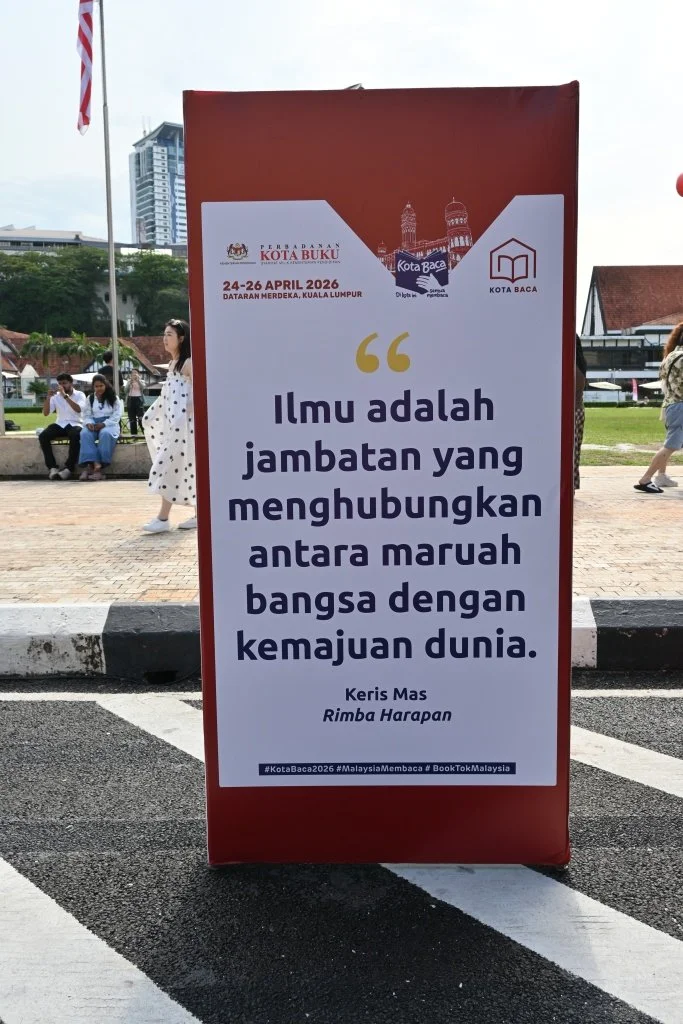
Keris Mas, whose quote appeared on one of the pillars: "Ilmu adalah jambatan yang menghubungkan antara maruah bangsa dengan kemajuan dunia." Knowledge is the bridge connecting a nation's dignity to the progress of the world. It's a sentence that only works if the bridge is actually open to everyone.
Low-cost alternatives to book-buying — libraries, digital platforms, second-hand books, and exchanges — are underutilised paths to building a reading habit.
Putting literary voices into public space, at scale — that's doing something. In a country where literary culture sometimes feels confined to academic circles and specific communities, seeing authors' words printed large across a public square felt like a quiet but deliberate act. Usman Awang. Fatimah Busu. Keris Mas. Nisah Haron. These are not household names for every Malaysian. Seeing their words printed large, in the middle of KL, with Bangunan Sultan Abdul Samad rising behind them, felt like an argument being made firmly but without fanfare: this matters. These people thought deeply about language and knowledge and what it means to belong to a reading nation. Their words are worth displaying in public.
I didn't disagree.
Would I go again? Yes — with more time and more specific intentions. I'd plan around a talk and arrive early enough to walk the padang before the afternoon heat sets in. I stopped at the National Library of Malaysia booth, where they were running an Information Literacy Awareness quiz — scan a QR code, answer a set of questions about how to find, evaluate, and share information responsibly, and walk away with a free gift. I scanned, answered, and left with a green Perpustakaan Negara pencil pouch I wasn't expecting. It was a small thing, but it stuck with me as the kind of detail that makes an event feel considered rather than just commercial.
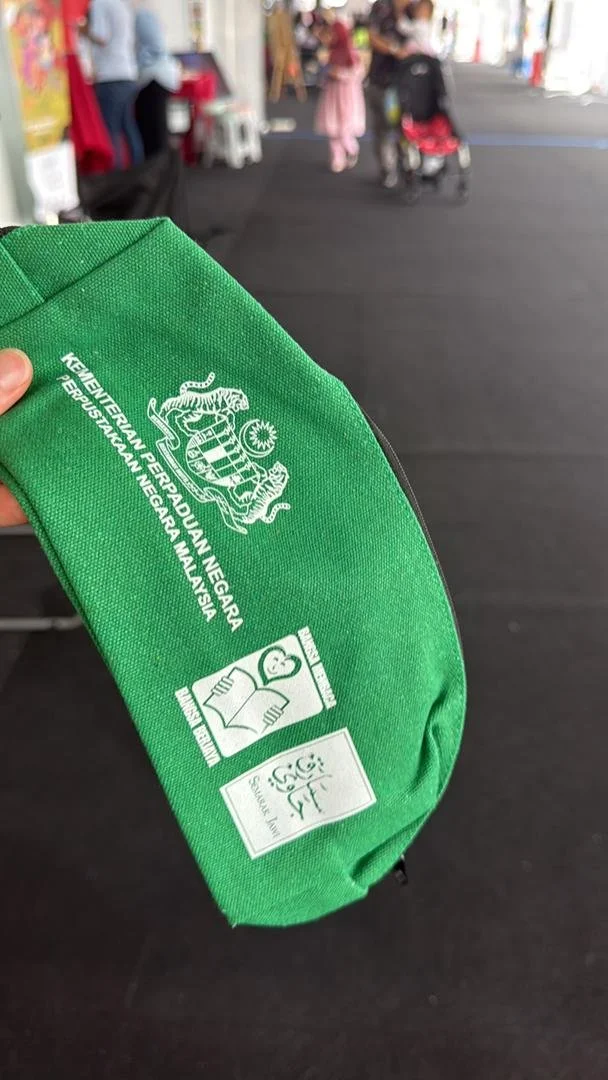
Free pouch for answer questions at Perpustakaan Negara Malaysia booth
What I'd tell anyone thinking of going: Kota Baca is not a book fair in the way that a commercial fair is a book fair. It's closer to a public reading event with books attached. The energy is unhurried, the entry is free, and the setting — right in the heart of historic KL — gives the whole thing a weight it might not carry elsewhere. If there's one thing I'd love to see grow with the event, it's the range of languages represented — reading culture is richer when it's multilingual, and there's something exciting about the idea of a book fair where you might discover a title in a language you've never read in before.
That, and the quotes. Definitely the quotes.
Frequently Asked Questions
When is Kota Baca held?
Kota Baca 2026 ran from 24 to 26 April 2026 at Dataran Merdeka, KL. Future editions are expected annually around World Book Day (23 April) — check Perbadanan Kota Buku's official channels for 2027 dates.
Is Kota Baca free to enter?
Yes — entry is free. Books and merchandise are available for purchase at booths, but browsing, talks, and most activities cost nothing.
Where exactly is it held? Dataran Merdeka (Merdeka Square), directly in front of Bangunan Sultan Abdul Samad in historic downtown KL.
How do I get to Dataran Merdeka? LRT to Masjid Jamek or Pasar Seni station (both are a short walk). By car, parking is available at surrounding areas. Grab drops directly at the square.
What can you do at Kota Baca beyond book shopping?
Attend talks and stage performances, visit the AI Learning Zone, collect stamps in the Kota Baca Passport, donate pre-loved books at the Stesen Derma Buku, and explore the themed art installations across the grounds.
You might also enjoy
🌏 Wander · Kuala Lumpur, Slowly
🌏 Wander · Zoo Negara, From the Other Side: A Behind-the-Scenes CSR Experience Most Visitors Will Never Have