Photo of the Week: One Bridge. One Valley. What Xinjiang looks like when you can't stop.
A single image. A single decision. What I noticed when I stopped.
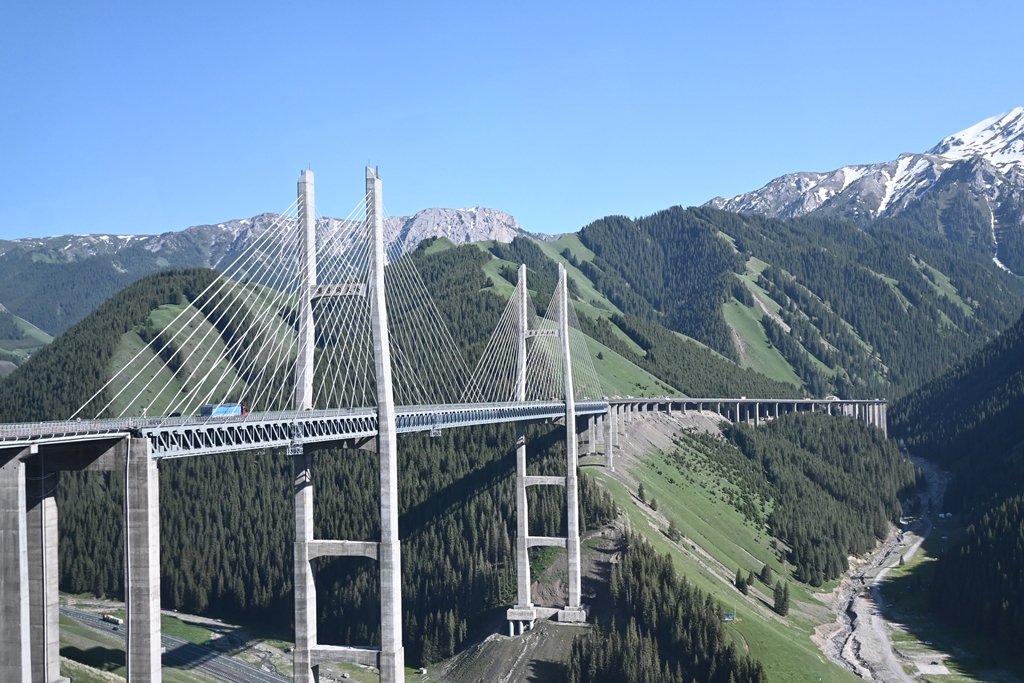
A great structure photograph works when the camera finds both the scale of what's built and the landscape it's built into — so the viewer understands not just what they're looking at, but how impossible it seems that it's there at all.
My camera is always ready. In my hand. Not in the bag, not on the seat beside me, because the moment you put it away is the moment something appears.
This was taken through a bus window somewhere in Xinjiang, moving. I had maybe thirty seconds from the moment the Guozigou Bridge entered the frame to the moment it disappeared behind us. I didn't choose the angle or adjust the settings. I just shot as many frames as I could — collapses the parallelism without losing the meaning and hoped one of them held.
This one held.
What I was trying to capture wasn't the bridge itself — it was the drop. The way the cable-stayed towers rise above the road deck while the valley floor falls away so far below that the river at the bottom reads as a thin line. The mountains behind it, still carrying snow at the peaks, made the whole thing feel engineered into the wrong place by someone who simply refused to accept that the terrain said no.
No photo fully earns a structure like this. The Guozigou Bridge sits more than 180 metres above the valley floor. You don't feel that in an image. You feel it in your stomach when the bus crosses it and you make the mistake of looking down.
But sometimes a photograph doesn't need to capture everything. It just needs to make someone want to look for themselves.
The shot wasn't planned. That's the only reason it worked.
Location: Guozigou Bridge, Xinjiang, China
Frequently Asked Questions
How do I photograph large structures or bridges while travelling by vehicle?
Keep your camera in hand, not stored away — landmark structures appear and disappear faster than you expect from a moving vehicle. Set your camera to a faster shutter speed before you board to account for motion blur, and shoot in bursts rather than single frames. You won't always get the perfect angle, but one frame in ten will usually have the composition you were reaching for.
How do I capture scale in architectural photography?
Scale reads best when you include something familiar — a vehicle, a person, a tree line — alongside the structure. In this case, the cars on the bridge deck and the river far below both serve as reference points that tell the eye just how large the drop really is. Without them, the bridge reads as abstract. With them, the height becomes legible.
Is it worth photographing famous structures even if photos can't do them justice?
Yes — but adjust what you're trying to achieve. Don't attempt to replicate the structure's impact. Instead, find the one detail or angle that surprised you personally, and photograph that. A record shot of the whole thing tells people what it looks like. A personal shot tells them how it felt to be there.
You might also enjoy
🌏 Wander · Northern Xinjiang: Bare Land, Sayram Lake, and Everything Between the Postcards
📸 Capture · The Stories Behind My Favourite Travel Photos