Photo of the Week: One Station. One Lake. What Shizuoka looks like when you earn the view.
A single image. A single decision. What I noticed when I stopped.
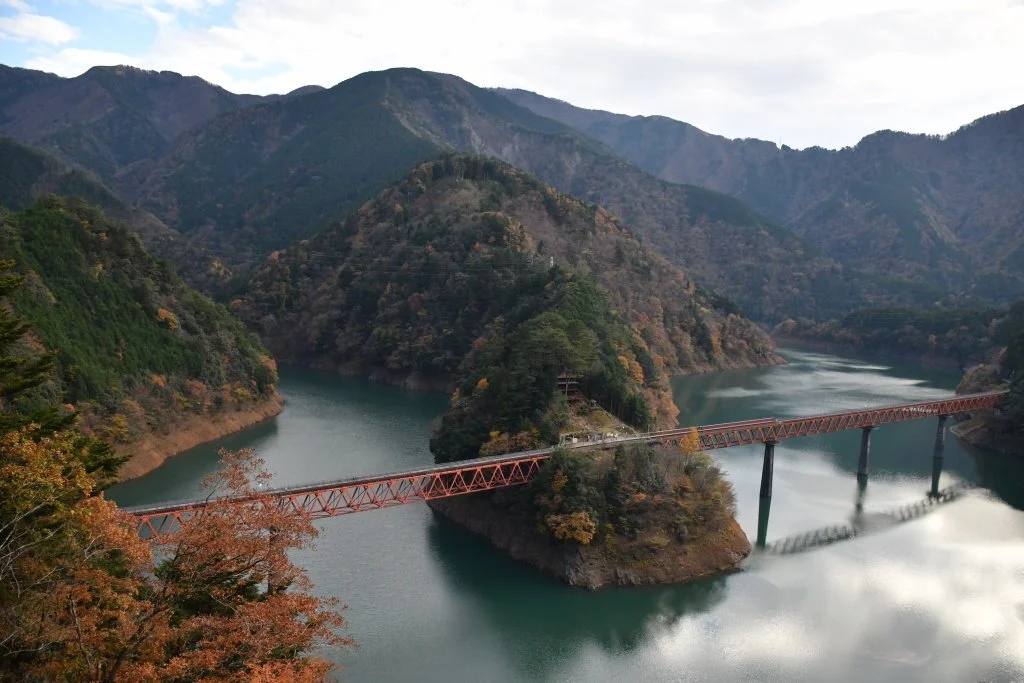
Getting to a viewpoint is part of the photograph. The effort changes how you look when you finally arrive — and what you're willing to see.
Getting to Okuoikojo Station is not a casual decision. It takes multiple train connections, a timetable you cannot afford to misread, and the understanding that missing any one of them means the day is over — you won't make it there and back on the same trip.
We made every connection. We arrived.
And then we had to turn around and catch the next train out.
There was no waiting for the light to shift. No second attempt. The view had a time limit — next train out, whether I was ready or not.
So I looked. Properly, quickly, the way you only look when you know you won't be coming back.
The autumn had turned the mountains into something I wasn't prepared for. The lake held the colour of the sky in a way that felt wrong for water — too green, too still — the kind of colour that looks wrong for water. The red of the bridge pulled everything together: the rust of the leaves in the foreground, the steel crossing the water, the line of it disappearing into the treeline on the far side.
The train passing through would have been a bonus. What was already there was enough.
The harder the place is to reach, the more honestly you look at it when you arrive.
Location: Okuoikojo Station Observatory, Shizuoka Prefecture, Japan
Frequently Asked Questions
How do I plan photography at locations with strict transport schedules?
Research the timetable before you go and build your itinerary around the return journey, not the arrival. The mistake most people make is planning how to get there without accounting for how to get back. At remote railway locations especially, missing the last connection out can mean being stranded — know your exit window before you step off the train.
How do I make the most of limited time at a photography location?
Know what you're looking for before you arrive — not a fixed composition, but a quality. In this case it was the relationship between the bridge and the water. With limited time, having that clarity meant I wasn't wasting minutes deciding what to shoot. I already knew. The time pressure became useful rather than stressful.
How do I photograph autumn foliage without it looking oversaturated or generic?
Resist the temptation to increase saturation in post-processing. Autumn colour reads best when the surrounding tones are muted enough to let it contrast naturally. In this image, the teal of the lake and the grey of the sky are doing exactly that — keeping the red and orange of the foliage from tipping into unreality.
You might also enjoy
🌏 Wander · Northern Xinjiang: Bare Land, Sayram Lake, and Everything Between the Postcards
📸 Capture · The Stories Behind My Favourite Travel Photos